You Can See Everything (2026) Review: Holmes, Unblinking — Nathan Fielder's Elizabeth Holmes Documentary Starts as a Portrait and Ends as Something Much Stranger
Nathan Fielder and Lance Oppenheim spent three years on a documentary that starts as an intimate portrait of a convicted fraudster and ends up asking a much bigger question about who gets to control a story once it's been told.
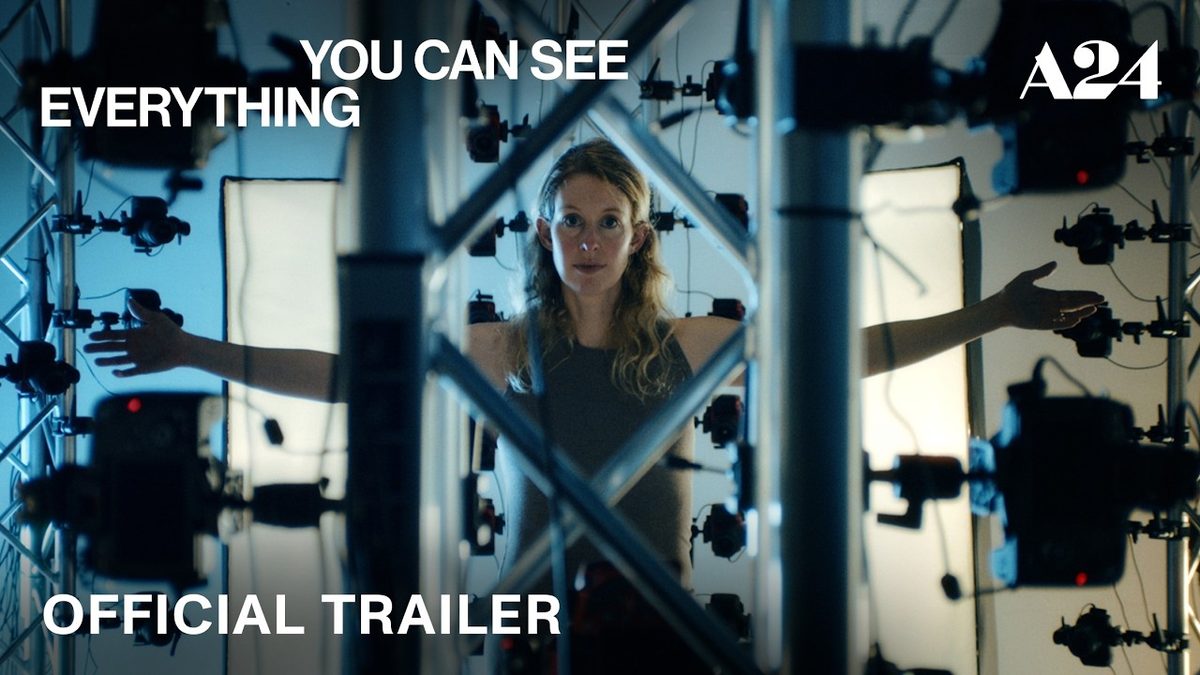
Elizabeth Holmes spent eleven years convincing investors, journalists and eventually a jury that Theranos's blood-testing technology worked when it didn't. You Can See Everything opens with her doing something almost as strange: granting Nathan Fielder and Lance Oppenheim total access to her home for the 34 days before she reported to federal prison in 2023. What the two directors do with that access is the most structurally audacious documentary of the year, and arguably the best reviewed film of 2026 — it currently sits at 99% on Rotten Tomatoes and 98 on Metacritic, with a 92% "definite recommend" score from opening-weekend PostTrak audiences.
The film's first 90 minutes play almost straight: Fielder and Oppenheim simply document Holmes's last month of freedom with her partner Billy Evans and their kids, a fly-on-the-wall chronicle of a woman behaving as though the last decade didn't happen. Critic Sean Burns, writing for WBUR, describes her as "extremely strange," noting she "blithely insists she's done nothing wrong, asserting her innocence with a beatific glow and unrelenting eye contact that starts to feel like an act of aggression" — including, Burns writes, her claim that she's "never told a lie in her entire adult life." Fielder, whose entire public persona runs on being the most uncomfortable person in any room, finds himself outmatched: Burns notes he's "stuck playing the straight man because there's no way he can be the weird one in a house with Elizabeth Holmes."
Then, around the 90-minute mark, the film changes shape entirely. Holmes goes to prison and becomes unavailable to film, and the story picks up two years later without her — at which point, per Burns, the movie "folds in on itself with a bravura, prankish spirit akin to Orson Welles's 'F for Fake,'" turning into what he calls "a dazzling hall of mirrors and reenactments" that re-examines its own earlier footage from new angles and interrogates how recreations calcify into record. SlashFilm's review makes the sharpest case for what the back half is actually doing: by the second act, "the real subject of this film isn't Elizabeth Holmes, but rather Nathan Fielder" himself, and the question stops being about Holmes's guilt and becomes something closer to how much of what any of us believe about another person comes from how someone else chose to tell their story.
That pivot is either the smartest thing a documentary has done all year or a bait-and-switch, depending on who's reviewing it, but the critical consensus has landed overwhelmingly on the former. Variety called it a "shameless, fascinating, reality-TV-eats-its-tail look at entitled duplicity," and even outlets skeptical of Fielder's track record have come around on this one specifically — it's rare for a nearly three-hour documentary about a already-exhaustively-covered subject to generate this much genuine surprise two-thirds of the way through its runtime.
None of this would land if Fielder and Oppenheim had just made another Theranos explainer. The Inventor and The Dropout already told the factual version of Holmes's rise and fall in exhaustive detail years ago; this film isn't competing with those projects for information, it's doing something those more conventional treatments structurally couldn't — using Holmes's own cooperation and apparent self-belief as raw material, then stepping back to examine what it means that she gave two filmmakers unrestricted access to perform her own version of events on camera, days before losing control of her life entirely.
The box office backs up the reviews: You Can See Everything opened to $15 million from just 855 theaters, a $17,543 per-screen average that made it, by multiple outlets' counts, the best opening for a non-music documentary since Michael Moore's Fahrenheit 9/11 in 2004, and the biggest release on fewer than 1,000 screens since Borat in 2006. A24 reportedly spent less than $10 million combined on production and marketing — meaning a film this strange turned into one of the studio's most efficient hits of the year almost by accident.
You Can See Everything is currently playing in theaters, and it's the rare documentary where the pitch — "disgraced tech fraudster lets two of the most unpredictable filmmakers working today into her house right before prison" — undersells what's actually on screen. It's not a Theranos recap, and viewers expecting another tidy true-crime indictment should recalibrate: this is a film about the unreliability of access itself, and it earns every minute of its unusual length.
Related movies
Related articles
- Primetime (2026) Review: Pattinson as Chris Hansen — a Horror-Movie Monster, and A24's Camera Never Blinks
- Verity (2026) Review: Anne Hathaway Saves a Flat Thriller — Colleen Hoover's Bestseller Gets a Faithful, Oddly Tame Adaptation
- Musk (2026) Review: A 4-Hour Indictment, Hurt by Gimmicks — Alex Gibney's Documentary Is Comprehensive and Damning, Except When It Reaches for a Digital Elon Clone
- Street Fighter (2026) Review: All Hadouken, No Heart — Game-Accurate Moves Can't Save a Script That Forgets to Finish Its Own Story
- A24's Doc Posts the 2nd-Best Documentary Opening Ever — Street Fighter Won the Weekend With $31 Million, But You Can See Everything Had 1,300+ Sellouts
- Street Fighter Opens at No. 1 With $31 Million as A24's You Can See Everything Stuns With $15 Million
Sources
- WBUR — Elizabeth Holmes documentary 'You Can See Everything' is a wild, mind-melting movie
- SlashFilm — You Can See Everything Review: A Mystifying Masterwork Of Mind-Melting Manipulation
- Variety — 'You Can See Everything' Review: Nathan Fielder's Documentary About Elizabeth Holmes
- The Wrap — 'You Can See Everything' Earns Largest Doc Opening in 13 Years
- IMDb — You Can See Everything (2026)