The Cat in the Hat (2026) Review: Critics 47%, Families A — Bill Hader's Seuss Reboot Is a Frantic Sprint Audiences Forgive
Warner Bros. Pictures Animation's first feature turns the Cat into an HR problem and sends two kids through memory boxes, and critics say it never slows down.
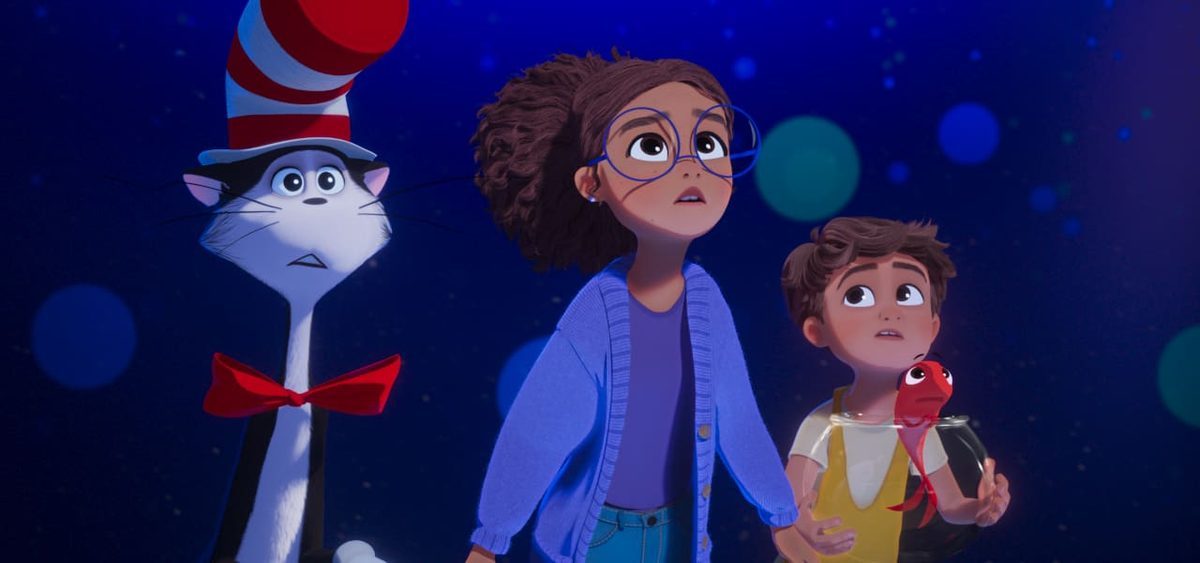
The Cat in the Hat is the rare big-studio animated movie that audiences like more than the people paid to review it. Warner Bros. Pictures Animation's first full feature, built on Dr. Seuss's most famous character, opened on November 6, 2026 to a 47% Rotten Tomatoes score from 68 critics (average 5.6/10), a 46 on Metacritic from 16 critics, and an 'A' CinemaScore from the families who actually bought tickets. Our FilmRated score lands between the two camps at 60/100: a lively, good-looking movie that is too busy to be great.
What the movie is about
Directors Erica Rivinoja and Alessandro Carloni do not simply retell the 1957 book. Their Cat (voiced by Bill Hader) is an employee of the Institute for the Institution of Imagination and Inspiration, a bureaucratic otherworld whose creatures visit children to entertain them. After a disastrous visit he is down to one last chance from Sherrie in HR, while the CEO, Mr. Hoogeboom, tricks him into stealing a time-reversing stopwatch called the Go-Backer. The Cat then turns up at the apartment of Gabby and Sebastian, siblings who have just moved to the town of Highland, where a strict landlady bans pets and forces them to hide their goldfish, Waffles.
Gabby wants to undo the move, so the Cat promises her the stopwatch. When it drops into one of three boxes holding the family's belongings, which his magic has turned into pocket dimensions, the group sets off on a couch through Sebastian's toy world, a circus show for a listless Psychic Narwhal, and a chase with a dragon-like creature called the Something. It is a lot of plot for a story that began as a few hundred rhyming words, and that is exactly where the critics' complaints begin.
Why critics split
The Rotten Tomatoes consensus calls it 'a high-energy sprint through the world imagined by Dr. Seuss' whose 'eagerness to please has some charm but could have benefitted from smaller stakes and a less frantic pace.' That sums up the pattern in the notices. RobertEbert.com's reviewer put the same objection more bluntly: the Cat 'could not escape the curse of being the latest IP adapted to the screen with all the bells and whistles but trades depth for excess, becoming superficial.' Other critics, as one report on the film's run put it, pointed to 'new distractions' that kept the emotional moments from breathing.
The emotional core is a good one. A girl who misses her old home, a boy who copes with toys, a mother working shifts at a new hospital: this is a family story about moving, and the memory-box dimensions are a smart way to show how two children carry a place with them. The problem the reviews describe is pacing, with a new gag or creature arriving before the last one has landed. For parents that may be a feature, not a bug, since the audience this film is built for does not sit still either, and the A from CinemaScore says those viewers were mostly satisfied. PostTrak had 81% positive, with 61% saying they would definitely recommend it.
The voices and the look
The cast is deep for an animated comedy: Bill Hader as the Cat, Matt Berry, Quinta Brunson, Xochitl Gomez, Giancarlo Esposito, America Ferrera, Paula Pell, Bowen Yang and Tituss Burgess, with Lorne Balfe scoring. The film's design leans into the Seussian shapes, with the red-and-white hat, the bow tie, the whiskers and the Things in their red vests and blue hair, in a glossy, saturated world that the studio's own press stills show to full advantage. It runs 107 minutes and is rated G.
The box office problem
The film's commercial story is much less kind than its audience score. It opened to about $20 million from 4,003 theaters, according to Variety, which called it a weak debut for an animated movie based on one of the best-known children's books ever written, and finished second behind Godzilla Minus Zero's $30.5 million. By November 16 its worldwide total stood at $55.7 million, of which $38.1 million was domestic, against a reported production budget of $86 to $92 million. A good CinemaScore can help a family film hold up week to week, but the film has not broken out. TheWrap reported in November that a sequel is under consideration and will depend on how the film is received, and Warner Bros. has a second Seuss adaptation, Oh, the Places You'll Go!, dated for March 17, 2028.
Verdict
If you are deciding whether to take young children to the theater, the answer is a cautious yes. This is a bright, fast, G-rated movie that children seem to enjoy, and the parents who go with them will find a sincere story under the noise. If you want the quiet, odd, hand-drawn rhythm of the book, you will not find it here, and the critics who say so have a point. A 47% critics' score and an 'A' from audiences describe the same film seen from two different seats. As of November 20, 2026 it holds an IMDb rating of 6.5, which is a fair summary: pleasant, overstuffed, and easier to like in the cinema than to defend on the page.
Related movies
Related articles
- New Movies Coming Out in November 2026: Release Dates — Godzilla, Dr. Seuss, a new Hunger Games, Disney's Hexed and the Fockers all land in one month.
- The Cat in the Hat: Release Date, Cast, Trailer — Critics Split at Metacritic 47 as Warner Bros. Bets on a $25–35 Million Opening
- Godzilla Minus Zero Box Office: $30.6M Opening Tops Chart — Toho's Subtitled Kaiju Sequel Nearly Triples Minus One and Beats The Cat in the Hat
- Josephine (2026) Review: De Araújo's Sundance Winner — Critics Land at 96% on Rotten Tomatoes and 85 on Metacritic for a Trauma Drama Built From the Director's Own Life